
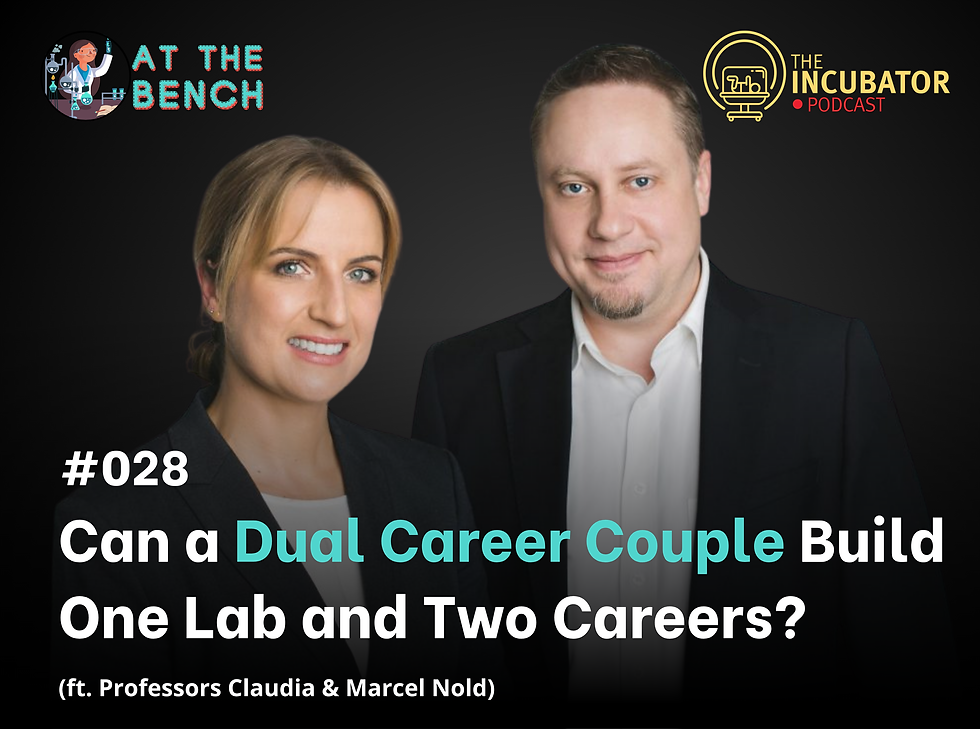
#028 - Can a Dual Career Couple Build One Lab and Two Careers?

Hello friends 👋
What happens when a scientist and a clinician scientist build a lab together, and an entire career, around the same disease? On this episode of At the Bench, Misty Good and Ben Fensterheim sit down with Professors Claudia and Marcel Nold, a husband and wife team running their lab at Monash University and the Hudson Institute. They trace their path from Charles Dinarello's cytokine lab in Denver to Melbourne, where they built a research program on IL-1 biology in bronchopulmonary dysplasia and necrotizing enterocolitis. They discuss the long road from preclinical models to their first anakinra clinical trial, the realities of running a dual career lab, and what it takes to keep going when experiments do not go your way.
Link to episode on youtube: https://youtu.be/i4vhffQdxSM
----
Short Bios:
Professor Claudia Nold is a world renowned expert in inflammation and cytokine biology, focused on newborn health. She has built a translational pipeline from fundamental immunology through to clinical trials, including the discovery of anti-inflammatory drug targets and biologics for new immunotherapeutics. Her research centers on preterm diseases including bronchopulmonary dysplasia, BPD related pulmonary hypertension, and necrotizing enterocolitis, as well as autoimmune diseases like lupus. Her work has led to an investigator initiated clinical trial, multiple patents, and industry partnerships, earning recognition including NHMRC and Australian Heart Foundation fellowships and the 2018 Monash Vice Chancellor's Award for Research Enterprise.
Professor Marcel Nold is a clinician scientist, Australian and German board certified paediatrician and neonatologist, with research spanning Germany, the USA, and Australia focused on interventional immunology and anti-inflammatory cytokines. His work has been published in journals including Science Immunology, Nature Immunology, and PNAS, and has attracted partnerships with Roche and the Medical Research Commercialisation Fund. Recruited to Monash Children's Hospital and Monash University in 2009, he has built a wide network of clinical and research collaborations across Australia and internationally. He uses bedside to bench and back approaches to develop new cytokine based therapies for early life diseases and autoimmune illnesses such as lupus.
----
The transcript of today's episode can be found below 👇
Misty Good (00:02) Welcome back to At the Bench, where we're incubating discoveries. My name is Misty Good, and I'm the division chief of neonatal perinatal medicine at UNC Chapel Hill. I'm very excited to be co-hosting today with Dr. Ben Fensterheim. Ben, would you like to introduce yourself?
Ben Fensterheim (00:21) Thanks Misty. Hi, I'm really excited to be back for another episode. My name is Ben Fensterheim. I am an instructor in neonatology at the Children's Hospital of Philadelphia, and I am so excited to be co-hosting today's program with Claudia Nold and Marcel Nold. I'll turn it over to them to introduce themselves, starting with Claudia.
Claudia Nold (00:48) Thanks for having us. It's really exciting and we appreciate the opportunity to share what we're doing. My name is Claudia Nold. I'm a pharmacist by training, then I thought pharmacy was a little too uninspiring, so I decided to do a PhD and stuck with immunology. I'm a professor here at Hudson Institute of Medical Research and Monash University. During my PhD I met Marcel, so I'll hand over to him.
Marcel Nold (01:24) Hello, it's a great pleasure to be here today. Thank you so much for the invitation, Ben and Misty. At this point I usually say I'm the husband, and that's true. Claudia and I have been working together for quite a while, and I'm sure we will talk about this later on. That while included starting off in Frankfurt, where we both trained and did our PhD and MD. It's a bit of a lab couple background story in case you wanted to ask about that later, but it wasn't boring overall from there forward. Claudia and I both did a postdoc in the US, then we were recruited to Australia, and we've been running the lab together since 2009. In addition to being a scientist, I'm also a clinician, a neonatologist, working at Monash Children's Hospital, and I've got an appointment at Monash University as a professor of pediatric immunology, and at the Hudson Institute together with Claudia.
Misty Good (02:37) I love this. There are so many topics to dig into, and I love that your work really sits at the intersection of immunology and neonatal medicine and therapeutic development. This is going to be a very exciting episode. I'm thrilled to call you collaborators and can't wait for you to tell the rest of the world about your research. Maybe you could start by telling us, you mentioned you started your lab together in 2009. What did you start working on, and how has that evolved to today?
Marcel Nold (03:26) Let me go back a tiny bit more, to the time we had in Charles Dinarello's lab in Denver. As most listeners would know, Charles is one of the godfathers of cytokine biology. He was really big in the IL-1, interleukin-1 field, and once you join that side of the river, you usually stick with it. Charles himself called it the "IL-1 mafia" versus the "TNF mafia," jokingly. We started working on anti-inflammatory cytokines then. I had a friend, still have a friend, Alex Feldman, who at that time was working in Melbourne at Monash Newborn, and he and the then acting director of the Ritchie Centre, Philip Berger, were having discussions about the immunological problems that underpin neonatal diseases, specifically BPD, bronchopulmonary dysplasia, or neonatal chronic lung disease. They felt we would be a good fit given the work we'd been doing on immunology and anti-inflammation, and asked whether we wanted to come Down Under. We visited Melbourne in 2008, a one-week whirlwind trip with something like ten interviews in that one week. After that went well, we started working, even while still in Denver, on the immune pathogenesis of BPD. That's how it all started.
Misty Good (05:18) Claudia, anything to add?
Claudia Nold (05:23) When Marcel said we moved in 2009 from Denver to Australia, we also moved as three, not two. We had a two-month-old, and I'm saying that for all the women in science listening. I thought, it can't be too difficult. As you all know working in the NICU, the delivery itself was a bit rough too. You don't plan these things. We moved here with a little girl who is a US citizen, my anchor child, because I love the US. It worked out.
Marcel Nold (06:01) Joke, joke, for all listeners, that was a joke.
Claudia Nold (06:06) It's really great to have multiple passports, I think. Our daughter came with us, and we started immediately and set up an animal model, which was critical for doing the preclinical testing of an IL-1 receptor antagonist. We discovered early on, as Marcel mentioned, that there was a lot in the literature pointing to IL-1 in bronchopulmonary dysplasia, which drove the idea of repositioning anakinra for BPD. For that, you need a translational model, and that was my task. It worked out, eventually, after a long time.
Ben Fensterheim (07:03) That's amazing. I'm curious, that's such a big change, moving all the way to Australia at that moment in your career with a new family. What inspired you to make that move when you did?
Claudia Nold (07:21) As a new mum, we discussed it for probably the whole nine months, whether we should do it, because we didn't have family there. What inspired me is that I've moved countries my whole life, this is my sixth move now, to Australia. I always like to see new things and just give it a go. Also the opportunities, because for a dual career couple it's not easy to get positions together in the same place, as a lot of you probably know. Especially for Marcel, who wanted to work as a clinician scientist, those opportunities are difficult to find. So it was a compromise. I was open to going far away, Down Under, and the plan was not to stay sixteen years. But that was the key, to achieve a career for both of us, and to make the decisions and compromises that come with that. It all works out, you just have to believe in it.
Misty Good (08:44) How did you decide you wanted to study similar things?
Claudia Nold (08:53) It was a symbiosis. I was the scientist, Marcel was the clinician scientist, and you usually seek out those collaborations. I think it's very important that clinicians and scientists work together. Not everyone has the opportunity to marry one, which also means you discuss things at the couch at night, or at the dinner table. Our kids by now know the words "cytokines," "lupus," and "BPD" in and out. That's the good thing, you have complementing qualities, complementing personalities, points of view, ways of looking at things, and that's how you move things forward toward translation. I think no one could do it alone. Together, it's possible. That's why we stuck together and focused on similar fields.
Misty Good (09:58) It's amazing, like a prolonged lab meeting that runs all through dinner and all day. I love the symbiosis, that's terrific.
Ben Fensterheim (10:14) It clearly shows how passionate you are about this work. To both invest so much time and thinking and talking about it is a good sign you're in the right field.
Misty Good (10:29) Since we're talking about both of you, how do you decide when to venture into a new field versus stay focused? Is there one of you who says "let's try this" and the other who says "no, we have to finish this first"?
Claudia Nold (10:52) That's a good one, Marcel, you go for that one.
Marcel Nold (11:01) Yes, clearly. That's part of the symbiosis too, because it's not always a symbiosis, there have to be discussions, sometimes passionate discussions. The distribution is that Claudia is usually the one who wants to stay focused and see things through. It's not that I don't want that, it's just that new opportunities come around. One of those was working on NEC, necrotizing enterocolitis, in addition to BPD, which is where we started. I think adding that to our lab's portfolio was a good idea, and Claudia agrees, although not always, but on this one she does.
Claudia Nold (12:05) Yeah, I do.
Misty Good (12:09) How did you decide to venture into NEC?
Claudia Nold (12:17) We had the opportunity when Sam Foster joined the Hudson Institute. He brought a lot of knowledge on the microbiome, and that was one aspect. Decisions need to be strategic, especially in Australia, when you need to ship samples and make things work logistically. So he came. We also had amazing collaborators in clinics in Frankfurt who said, "we'll collect samples for you." You need the right people to drive things forward. Now we have you, Misty, and that's an excellent symbiosis, because you can have the greatest idea, but if you don't have the right players who pass the ball instead of keeping it to themselves, it doesn't work, like in soccer. If you have a great team, you can play the sport. This started over a beer back home in Frankfurt, with good connections to surgeons, and then Sam came on board. Sometimes you have to be at the right place at the right time.
Marcel Nold (13:41) To add to that, on the wards, although thankfully NEC is not very common and our unit, Monash Newborn, has very low NEC rates, we are still one of the surgical referral units. So we get referred babies with NEC or other surgical gut problems, and sometimes see our own babies develop NEC. There's also a relationship with chronic lung disease, babies who have NEC are much more likely to go on to have bad lungs. That clinical context intrigued me, and studying whether BPD and NEC are similar in their pathoimmunology is one of the big questions in this field that I think we can contribute to answering.
Claudia Nold (14:43) Another aspect I'm remembering now is that since we worked on interleukin-37, which has anti-inflammatory agonism, the first papers came out showing it was beneficial in inflammatory bowel disease, co-authored by us. We thought it might also be good for NEC. At the same time we were developing, and still are, an IL-37 Fc fusion for drug purposes. So that was the niche. As the scientist, I'm talking about needing to work with clinicians, there's no point doing something without a symbiosis with the clinic. That's how we started looking at NEC, and the paper with Bütner came out in 2022.
Misty Good (15:48) I love that, being in the right place at the right time. Thinking about getting introduced to you both, and now we're talking all the time and co-mentoring a grad student trying to solve this together. We still see it. Just last night I came in and got a patient sample from a third-look surgery. We're still seeing it, being a referral center, and we have to do better for this disease and all the complications of prematurity.
Claudia Nold (16:28) I presented our study yesterday at the pediatric surgery department at Monash Health, to make the registrars aware that we need samples and how they should collect them. I also showed a photo of you and the others working with us. We can only tackle this together.
Ben Fensterheim (16:28) I think something you, sorry, no, go ahead.
Claudia Nold (16:57) In science, one person has the samples, the other has some funding. Since things have become difficult, it's almost like a puzzle. If you put the pieces together, eventually it becomes a picture, and things become clearer. If you work together, and help each other out when the other is in need, I think that's how, in the end, you achieve helping patients.
Ben Fensterheim (17:38) A few things you said are really striking. One, a lot of what you're doing now is motivated by clinical observations from patients. Also, a shout out to the immune system, you noticed patients with NEC have an increased chance of developing lung disease, suggesting some connection between the gut and the lung, and shared pathology. I always think about the immune system and shared pathology between organ systems, and it seems like such a natural place for you to go. As immunologists who aren't organ-specific, you're really studying systems that can cause disease in different locations.
Marcel Nold (18:32) You just used the word "systems." That's actually one of the research areas we're trying to move into more now, which you can't really avoid in this day and age of large datasets and omics technologies becoming more available, even though they still cost an arm and a leg. I'm actually working on finishing a paper where we take a systems biology view, using a large number of flow cytometry datasets and an 11,000-feature proteomics dataset together, to understand what's going on in terms of drug activity and anakinra in babies, as well as what's going on clinically. I should mention, one of our postdocs and a clinician scientist, Scott Stansfield, managed to overcome the hurdles of our EMR system and extract massive amounts of clinical data as well. So there's the third "omics." Putting that all together is a huge challenge, and me not being a bioinformatician makes it even harder. But I think it's becoming more important, and it will ultimately allow those insights into commonalities and differences, which patients develop NEC or don't, BPD or don't, or white matter injury of the brain, which is another complication we're not directly working on in our lab but with collaborators. We shouldn't neglect the brain.
Ben Fensterheim (20:46) Systems immunology, or systems biology, is a blessing and a curse. Every time I engage in a systems project I think, I'm definitely going to discover the truth, I'm looking at everything, how could I not? But at the end of the day, while I learn a lot, you still have to do mechanistic biology to actually show that one protein does one thing, because that's ultimately what you bring forward. I had a similar experience in graduate school, when systems biology and bulk RNA sequencing were just starting. Then I went to medical school, residency, fellowship, and came back to, "what, you haven't done single-cell RNA sequencing yet?" It had all evolved in the meantime. It's amazing the technology is there, and I think merging that with more classic forms of scientific discovery is the task now.
Marcel Nold (21:48) Without directly asking your age, Ben, I'm sure you're a digital native, whereas others on this call are not. I remember when I wrote my thesis, I still went to the library and photocopied papers to highlight with a highlighter. My supervisor wrote, typed papers on a typewriter, then sent the physical paper to journals. That was the previous generation. Still, I think you've got a bit of an advantage there.
Ben Fensterheim (22:25) Even now, I've always had internet access since I've been in science, so I've had it easier, now it's just a click of a button and I get the paper and find exactly what I'm looking for. I feel blessed to have that. Things have changed, that relates to a question I wanted to ask, how do you think science in neonatology has changed over the time since you started versus today? I've felt a change even just in the last five to ten years since I've been in the field. I'm curious if you've noticed changes too, maybe Australia is different, and which direction you think the field is moving in.
Claudia Nold (23:21) I have a practical answer that was really important for me at the bench. Marcel had ideas about studies and would say, "we get 500 microliters of blood," and we had these tiny amounts of plasma. When we started, as Marcel mentioned in Denver, we were establishing, together with R&D Systems, protein profilers that still required 100 microliters of plasma. From a practical perspective, I think we have way more opportunities now, you can go down to five microliters on a bench assay and don't have to do mass spec the way it used to be. That opens up opportunities to do research in this field, because of the practicalities. If you have a roadblock where you don't have enough sample, that opens every door, what we can do now with very little sample, or even in NEC, when we get just a tiny piece of tissue, you can do so much. That's from my scientific perspective. Then, yes, you can answer almost everything when you have the money and the right team.
Marcel Nold (24:51) From the clinical perspective, there's also been a shift, which in my opinion is going in the right direction, to recognize that preterm babies are at the beginning of their lives and we have to be very careful what we do, since they can't make their own decisions. Nonetheless, that's not a justification to deprive them of medical progress. It's moving in the direction of recognizing that preterm babies deserve medical progress just like any other patient, and that with the right safety nets in place, clinical trials not only can happen, but should happen.
Misty Good (25:44) I agree, I couldn't agree more. I think babies need science. Everyone talks about them being a vulnerable population, very fragile, but they need our advancement, new medications, and novel therapeutics. You brought up clinical trials and anakinra, I was excited to ask about that, walking us through your bench-to-bedside journey. When you think about the neonatal immune system and impacting it with therapy, is there an immune-related biomarker that would tell you the right timing for giving anakinra or another immunotherapy? What are your thoughts on that, from your work at the bedside?
Marcel Nold (26:46) Do you want me to start, Claudia?
Claudia Nold (26:50) Go ahead.
Marcel Nold (26:50) There were actually several questions in there, Misty.
Misty Good (26:57) I know, there are just so many things to dig into.
Marcel Nold (27:01) Let me start with how the journey went. We touched on the early parts, coming from an IL-1 lab, and anakinra, with its very well-established safety profile, has disadvantages in other populations, such as not being quite as active, you need to give it more often than TNF blockers, for example, and you need to inject it subcutaneously or IV. These are disadvantages for adults and older children, but in a NICU, intravenous administration is something we do all the time, and we monitor babies continuously anyway. A short half-life is actually a good thing, because when you stop treating, the drug leaves the body quickly, and you don't have an antibody lingering for a month. Infection, as you mentioned, was one of the main concerns we needed to think through. We took the long way to be sure we were doing the right thing, starting by understanding the role of IL-1, building on the work of others too, which is important to say, it's not only you, and it's great if others show similar things and validate your concept, because you don't want to be the only one showing something. We started working on IL-1, first in BPD and later other diseases, in 2008, and the first clinical trial, the anakinra pilot, started in 2022. That's quite a long journey, but I'm glad we did it this way, and along the road started collaborating with fantastic experts, such as Carl Kirkpatrick and David Mills, pharmaceutical scientists, David also a clinician and nephrologist and clinical pharmacologist with a lot of knowledge in clinical trials, and Rod Hunt, also with great knowledge in clinical trials at Monash Newborn. We had the right team in place to move forward with that first clinical trial. That made us feel so much better that we were doing the right thing in terms of the right drug, the right patients, and the right doses. Lots to talk about there, but I'll move to your second question, about biomarkers. It's related. At the moment we give anakinra essentially prophylactically, to babies at the gestations where the risk of disease is highest, so the risk of a new drug is justified. It would of course be ideal if we had a biomarker to show which babies would benefit from anakinra, it would be naive to think anakinra is a magic bullet, it isn't, there are no magic bullets. This is one of the parts we're also working on, through our proteomics, looking at which mediators change with anakinra, how the anakinra babies behave in the proteome and flow cytometry, to understand this better. I think it will require a larger cohort, and hopefully we'll be able to do this in the phase three trial we're also planning. Out of that phase three trial, we hope not only to show anakinra is safe and effective in treating complications of prematurity, but also understand which babies will benefit the most. I've talked a lot, over to Claudia.
Claudia Nold (31:29) I want to comment, because early or mid-career scientists might be listening, and when someone after ten or twelve years tells you a story, it always sounds like a German autobahn, 200 km/h and you arrive. It was not like that at all. Establishing models, changing time points in preclinical models, when other cytokines have their highest endpoints for harvesting, complicated, especially in neonatal preclinical models, are very difficult, as anyone who works with NEC or BPD models knows, getting mice time-mated is sometimes a disaster. Don't give up, that's my message, just keep trying. There was a point where we were ready to quit, we had a massive discussion, almost a fight, we actually fought, about chucking the whole thing. I said, no, let's try one more thing, and that ended up working. So, don't give up, keep going, as long as you breathe, fight, as long as there's funding. That's my message. We had an amazing PhD student at the time, Christine Bui, and I want to mention her, and Ena Wurzel too, who went down with us and injected mice even over Christmas. That's the message I want to get across, it's not an autobahn, it's off-road.
Ben Fensterheim (33:14) That's fantastic to hear, and shows the value of what you're saying. It would be so easy to get an idea, try one cytokine blockade experiment, see it doesn't work, and move on. But you trained in an IL-1 lab, this was something you were experienced in, you weren't about to give up after one or two experiments. You spent time and developed the story, understood what was going on, and that persistence and understanding got you to the point of saying, this might actually work. The commitment over the long term really shows, and was probably key to your success.
Claudia Nold (33:59) You also have to have others, in the team, it's not just one person not giving up. Sometimes I was ready to stop and Marcel kept going, and vice versa. You need a team, and someone with an idea.
Misty Good (34:26) Back to the symbiosis, when one of you is resilient, the other is ready to give up, and you balance each other out. I love that aspect of the story. I want to ask, since I was going to ask about preclinical models and how you determined dosing and timing strategy, but really, how did you not give up? That's one of the hardest decisions I have to make as a PI, when to pivot and when to let a graduate student go down the rabbit hole versus pull them out and not waste their time. Do you have advice on that?
Marcel Nold (35:11) I can tell a little story, I don't have a perfect answer. About my very first endeavor in science, as a medical student, which is what you generally do in Germany, you start a thesis and try to finish it during medical studies, so you're allowed to call yourself a doctor, otherwise you're a physician but not a doctor, which is confusing to patients. I went to a basic science lab, with an anatomy professor named Oelschläger, who got me excited about a project on African mole rats. These rats dig tunnels that are completely straight for kilometers without ever surfacing, and they're essentially blind. His reasoning was there must be some magnetic orientation system in the brain, and he thought it would be a cool project. I agreed and started, but not many things went right, antibodies didn't work, equipment broke down, and even though everyone did their best, the project wasn't moving along. Medical student projects at that time were supposed to be pretty short, but I was prepared to do more. Professor Oelschläger said I should probably pivot, and I disagreed with his decision to take me off the project, but in the end he convinced me it wouldn't be smart to invest that much time in something so uncertain. I left his lab, which we were both sad about, and did something else, immunology, which was exciting and turned out well. In the end, this mole rat project was published in Science by someone else in Professor Oelschläger's lab. It took another three or four years, but they found the magnetic orientation system in the rat's brain, and it got published in Science. So he was right, in a sense. I don't know if the right decision for me to stop was the same as the right decision for him to say stop. I don't have an answer.
Ben Fensterheim (38:23) I love the metaphor of these animals digging without knowing where they are. If that's not the perfect metaphor for staying in science, I don't know what is.
Claudia Nold (38:34) It's like gold digging, and then you find a little nugget.
Marcel Nold (38:36) I hadn't thought of that, that's really good.
Misty Good (38:46) Both of you have trained so many students and early career investigators, any advice you'd give?
Claudia Nold (38:58) Sometimes, I know it's not scientific, but it's a gut feeling. You go for a walk or a run, think about it, and that's how I do it. Not very scientific, but that's it.
Ben Fensterheim (39:37) That's a great story, something I'm thinking about as I make important career decisions. Good to hear it.
Marcel Nold (39:50) I was going to say, luck and gut feeling are important, but you can also, I don't know if "force" is the right word, force your luck to some degree. There's a German saying, sayings don't always translate well, but it essentially means you will be lucky if you try hard. This is one thing I say to everyone who starts in our lab, Claudia and I sadly can't co-supervise students anymore, because of rules around married couples, don't get me started, but it is what it is. I say to those students, you get out what you put in. Even if you're not lucky, you'll have things to write about, to talk about, to present. That, alongside trust, being able to trust each other on all levels and with all team members, is probably the most important aspect of early career projects in our lab.
Misty Good (41:21) That's great advice. Ben, as a new instructor, what advice do you have for someone at his stage, starting his career, excited about science, but it's easy to get discouraged in the funding climate? What do you wish someone had told you at that stage?
Marcel Nold (41:51) Do you want me to start, Claudia?
Claudia Nold (41:55) Sure, go ahead, clinician to clinician is probably easier.
Marcel Nold (41:56) First, it's really important that if you want to be a clinician scientist, you're passionate about it, because it is a huge investment, essentially doing two careers, and you only have 24 hours like everyone else. You have to invest more than others if you want to do it right. But if you're passionate, it's the best thing you can do for a job, this is what I've always wanted to do. Going back to one of your earlier questions, what I was passionate about when I started is actually what I do now, working with patients, understanding the problems, and doing what I can, together with a fantastic team, to try to solve them. If you're passionate about this, things will fall into place. Another important aspect is finding the right team. If you're starting your career, that's hard because you don't really know who you'll work well with. You can get advice from others about who is a great mentor or supervisor, but you need to click with them, you'll be working with their team a lot more than with them directly. Make your decisions consciously, don't only talk to the supervisor. Once you find your place, stick with it, and you'll be rewarded.
Misty Good (43:54) That's great, Claudia?
Claudia Nold (43:57) You get the scientist's view from me. I think clinicians have an amazing opportunity, because, as Marcel said, it's tough to have two jobs, but you have the safety net of always being able to go back into clinics, you're not losing your job. In some countries there's tenure track, in others there's not, in Australia for example it's fellowships until you retire for most scientists, and if you're not in that small percentage who get fellowships, you have to find another way. That's the opportunity clinicians have. What I miss, since I was always working in the pharmacy too during my PhD, is the patient aspect, where someone is happy and grateful for what you do for them, and you get feedback, whereas in science, as you pointed out, when do you know when to stop when things aren't working? It's always rejection, it doesn't work, it doesn't work, then finally, yes, it's working, ten times not working before that. You have more of a balance with clinical work, I see that with Marcel. That's one important aspect for clinician scientists to consider. I sometimes wish I could be a scientist without that, but I see it as an opportunity, a lot of scientists say you need a balance against the difficulty of science so you don't go a bit crazy. So, I think all clinicians should do science, because you have both opportunities, you always have something to fall back on, and you can drive things forward. It's yin and yang.
Ben Fensterheim (46:02) I've taken all of that to heart. It's true, I do wish more clinicians were in science. Right now it feels like a small group of us compared to science at large in neonatology, but the people who are there are really passionate, and it's a great group to be around. I also really hear the comments about finding the right people, finding the right mentors can totally change your perspective. For me, I recently realized I was too independent, too lonely in my work, doing things on my own, getting my own funding, after training for so long. Over the last year I started working with a friend, a true collaboration on a project, and it's reinvigorated my passion for science, because we can pick each other up when we're struggling and help with each other's weaknesses. I really feel what you've described.
Misty Good (47:35) I agree, science is a team sport, I always say do science with your friends and it makes everything better. If you have a bad day, or a grant doesn't get funded, you're in it together, and you can pick each other up and keep going.
Misty Good (48:00) We always like to close by talking about the personality of the lab, or any fun things you do together. Do you have any lab traditions you'd like to share?
Claudia Nold (48:16) We try to do things together with the students, though it's become a bit less than I'd like, because of funding, even across the university, retreats and things like that have been reduced.
Ben Fensterheim (48:29) Come on, ELISAs are fun, right?
Claudia Nold (48:53) Well, yes, especially if you're looking at interferons, it becomes like a three thousand dollar kind of fun. Anyway, we do things, we go bowling together, we did a casino event with poker and roulette.
Claudia Nold (49:30) We did axe throwing, which I really wanted to go to, but I couldn't, I think one of the kids was sick.
Misty Good (49:43) We did axe throwing too, that was a good stress reliever, I think.
Claudia Nold (49:48) Yeah, we should do that one again.
Misty Good (49:52) We literally did laser tag, and I'm a little too old for that now, I think.
Claudia Nold (49:59) I would love it, but Marcel is so strict, even the kids couldn't have, I had to smuggle Nerf guns into the house, he was totally against it. I would love laser tag, I'm fully for it.
Marcel Nold (50:15) I know you would.
Claudia Nold (50:19) You're the father of two boys, what are you supposed to do, they love that stuff.
Marcel Nold (50:23) Don't shoot each other, that's an important life lesson, I think.
Misty Good (50:30) That's a good life lesson.
Claudia Nold (50:35) As long as they don't shoot at you.
Marcel Nold (50:39) That goes a bit against the lesson. One other thing Claudia reminded me of, we went cherry picking too, I thought, you can't cherry-pick your data, so you actually have to go pick cherries.
Misty Good (51:03) That's some great advice, cherry-picking.
Ben Fensterheim (51:07) You've got to get it all out in the field, leave it away from the lab.
Marcel Nold (51:16) We've got great orchards around Melbourne, if you ever visit in summer, that's always a fun activity.
Misty Good (51:27) I think that was just our invitation to come visit, we need to travel to Australia.
Claudia Nold (51:33) I can promote the Cytokine Society meeting in 2027 in Sydney, that's happening next year, a great opportunity for those who work in inflammation and cytokines and want to come Down Under. Look out, it'll be advertised soon, cytokines in Sydney from the Cytokine Society.
Ben Fensterheim (51:59) That's amazing, I'm writing it down, abstract's going in, I've never been.
Misty Good (52:01) We will be there. Terrific. With that, we'll close, and hopefully we'll see everyone at the Cytokine Society meeting. It's really been a pleasure, Claudia and Marcel, to host you on At the Bench, and we're honored to have you and hear about your research and your journey in science, building a joint lab together. It's really remarkable. I applaud you for all you do and can't wait for the future discoveries from your team.
Marcel Nold (52:42) Thank you so much, it's been a great pleasure.
Claudia Nold (52:42) Thank you for having us, nice to meet you, Ben.
Ben Fensterheim (52:49) Yes, thank you all, and thank you for the advice. Great speaking with you.


This article is a valuable contribution to the field and a pleasure to read. I admire your ability to convey such detailed information in an accessible way. choicer voicer
For a browser title, Drive Mad online has surprisingly varied level layouts that keep the gameplay feeling fresh.