
#025 - Can We Predict Which Pregnancies Will Fail Before They Do?

Hello friends 👋
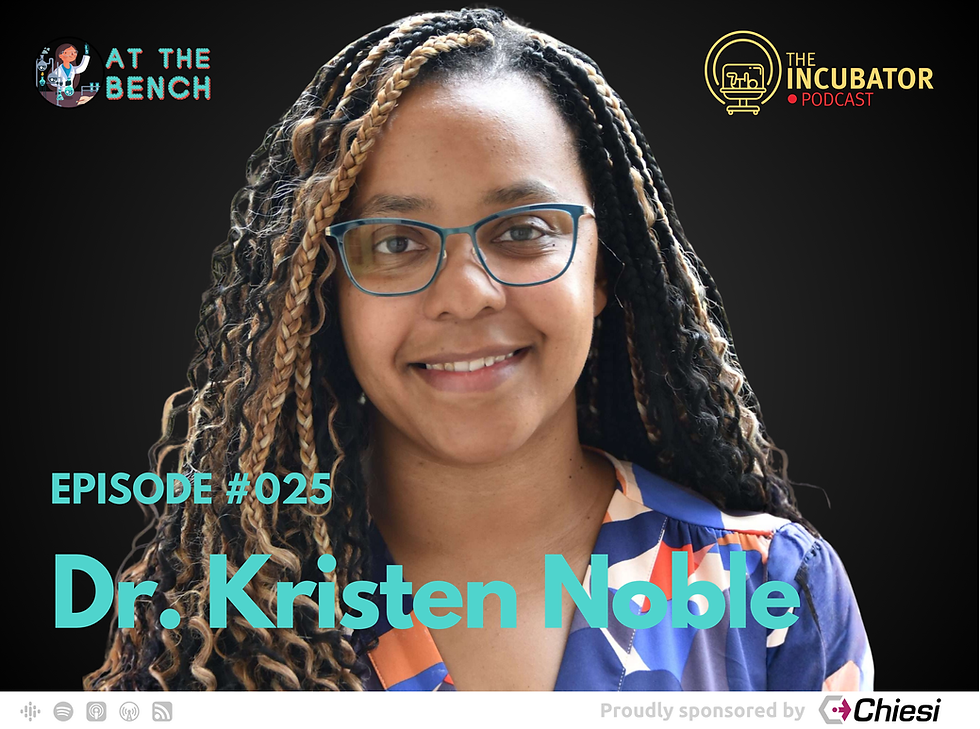
What is actually happening inside the uterus during a threatened pregnancy — and does the timing of infection change everything? In this episode of At the Bench, hosts Ben Fensterheim and Betsy Crouch sit down with Dr. Kristen Noble, assistant professor at Indiana University, to explore her work building a transcriptomic and proteomic atlas of intrauterine immune responses across gestation. Dr. Noble shares how clinical uncertainty at the bedside — that impossible question of deliver now or wait — drove her into the lab. She also opens up about navigating doubt early in training, finding the right mentors, and what it looks like to rebuild a research program from scratch at a new institution.
Link to episode on youtube: https://youtu.be/YjVV8-mRzWA
----
Short Bio: Dr. Kristen Noble, MD, PhD is a neonatologist and basic scientist who studies the intrauterine immune response to infection during pregnancy. Dr. Noble earned a bachelor’s degree from Vanderbilt University, followed by her MD/PhD degrees from Meharry Medical College. She matriculated through pediatric residency at the University of Tennessee Health Science Center in Memphis, TN and then returned to Vanderbilt for fellowship in Neonatology. She stayed as faculty at Vanderbilt prior to her recent move in 2024 to Indiana University where she is now an Assistant Professor of Pediatrics. Dr. Noble received a K08 career development award from the NICHD to focus on the placental host immune response to bacterial infection as a function of gestational age during pregnancy.
----
Featured Manuscripts From Dr. Kristen Noble
Kuperwaser F, Avital G, Vaz MJ, Noble KN, Dammann AN, Randis TM, Aronoff DM, Ratner AJ, Yanai I.Mol Syst Biol. 2023 Mar 9;19(3):e11021. doi: 10.15252/msb.202211021. Epub 2023 Feb 6.PMID: 36744393 Free PMC article.
Palmitate and group B Streptococcus synergistically and differentially induce IL-1β from human gestational membranes.
Gaddy JA, Moore RE, Lochner JS, Rogers LM, Noble KN, Giri A, Aronoff DM, Cliffel D, Eastman AJ.Front Immunol. 2024 May 23;15:1409378. doi: 10.3389/fimmu.2024.1409378. eCollection 2024.PMID: 38855112 Free PMC article.
Streptococcus agalactiae npx Is Required for Survival in Human Placental Macrophages and Full Virulence in a Model of Ascending Vaginal Infection during Pregnancy.
Lu J, Moore RE, Spicer SK, Doster RS, Guevara MA, Francis JD, Noble KN, Rogers LM, Talbert JA, Korir ML, Townsend SD, Aronoff DM, Manning SD, Gaddy JA.mBio. 2022 Dec 20;13(6):e0287022. doi: 10.1128/mbio.02870-22. Epub 2022 Nov 21.PMID: 36409087 Free PMC article.
----
The transcript of today's episode can be found below 👇
Ben Fensterheim (00:01) Hey everybody, welcome to At the Bench, the physician-scientist neonatology podcast. My name is Ben Fensterheim. You may remember my face from a recent interview where I was being asked the questions. Now I have the privilege of asking them to a fantastic up-and-coming physician scientist, Kristen Noble.
Ben Fensterheim (00:28) Before we get into that, I'm going to pass it over to my co-host, Betsy Crouch, to go over the next steps.
Betsy Crouch (00:38) Awesome. Ben, congrats on your promotion.
Ben Fensterheim (00:42) Promotion to instructor — yes, from fellow to instructor. Thanks for the congrats. I'm still looking for the next step.
Betsy Crouch (00:50) Aren't we all? But more specifically, congrats on your promotion here at At the Bench from guest to host. That is the important one — you should update your CV. As our listeners can probably tell from the vibe, it's a really fun group here. We're all earlier in our careers. Ben is an instructor, and our guest today, Dr. Kristen Noble, is an assistant professor at Indiana University in the Division of Neonatology. We're delighted to talk with you about your research program. And as our listeners know, I'm Betsy Crouch, also an assistant professor at the University of California, San Francisco — though I'm happy to say I'll be transitioning to associate this summer. Kristen, thanks for being here. Do you want to tell us a little about your research program and what's driving you these days?
Kristen Noble (01:44) Sure, absolutely. I'm really excited to be here. I've known Betsy and Ben for a little while now, so it's great to reconnect. I'm Kristen Noble — as Betsy mentioned, I'm at Indiana University. I've been here now for just a year and a half, after training and staying on faculty at Vanderbilt for a few years.
I moved my lab here — and by my lab I mean me — to Indiana, to really study how the timing of gestation affects intrauterine immune responses to infection. We're developing mouse models and trying to use human tissues as well, with the goal of building an atlas of transcriptomic and proteomic descriptions of how the intrauterine tissues respond to infection at multiple time points during pregnancy. We're really excited about the opportunity to do that here at Indiana.
Betsy Crouch (03:02) I'm so excited to talk about this. I was reading a lot about GBS (Group B Streptococcus) in preparation for our interview, and it's a great reminder of how essential that infection has been to our understanding of neonatal health — and how much work there still is to do.
Betsy Crouch (03:25) To get started, would you mind telling us a little about your background and what inspired you to become a neonatal physician scientist?
Kristen Noble (03:33) Sure. It's an interesting story — I'll start all the way back in undergrad. As a senior, I had the chance to take a seminar on how to read primary literature. I also tried to get into a research lab as an undergrad and couldn't — unfortunately, the instructor passed away the summer before I was going to start. But that was my first real exposure to understanding that, as much as we think growing up that science and medicine have all the answers, there are very fundamental questions still being studied. The most interesting questions seemed to be those foundational ones — how do cells communicate with each other? How does something like infection change that communication? I thought, of course we know all that — we're so advanced in science. That was my first real moment of realizing, wait, we don't know anything.
At the time, I was on track for medical school and met with my pre-med advisor to get a letter of recommendation. That was the worst meeting of my life. He told me I was not doctor material and that I should think about doing something else — maybe an X-ray technician or something like that. That was pretty devastating.
Betsy Crouch (05:44) Did you send him some of your papers?
Kristen Noble (05:48) No, I did not. Those are the moments in life when you're really vulnerable — I was about twenty years old — and I thought, this man knows exactly what he's talking about. I'm never going to be a doctor. So I went back home after undergrad, didn't apply to medical school, and got a job in a neuroscience lab at Case Western Reserve University. Maybe I can be a research assistant. I did that for a year, and in the meantime met some really fantastic people at Case who helped me work through that initial experience and convinced me to just try. So I did apply to medical school — I only applied to two schools — and got a call from Meharry Medical College saying they'd love to have me. I didn't even know what MSTP (Medical Scientist Training Program) programs were at the time.
Betsy Crouch (07:07) That's a compliment.
Kristen Noble (07:10) Exactly. I had no idea. But during my first year of med school, I went and talked to the head of the graduate school about research opportunities for medical students. She told me that the Vanderbilt MSTP had reserved two spots for Meharry students. You still had to interview with the normal MSTP class and be accepted, but those spots were available. Shockingly, a lot of med students don't want to add however many extra years for grad school.
So I applied to the MSTP and was accepted. There were some hiccups with timing and funding, but thanks to Terry Dermody and Susan Wente — who later became my mentor — they worked it out, and things took off from there.
Ben Fensterheim (08:24) I find that fascinating, as someone who also trained in the Vanderbilt MSTP system. I had a similar experience — maybe not quite as traumatic — but I also had significant doubt cast on me by others. It was actually through the Vanderbilt system that I regained confidence. When you got accepted and found yourself in combined MD-PhD training all of a sudden — how did that influence your perception of your career and yourself?
Kristen Noble (09:01) Great question. I actually did my undergrad at Vanderbilt — that's where the pre-med advisor told me I would not be a doctor. So there were mixed emotions going back. And it was interesting being a Meharry student at Vanderbilt, because there's a lot of history there. The first person I met when I started rotations said something like, "Oh, we're so glad you've been given this opportunity to be here." The assumption was still that I wasn't quite good enough — that it was a charitable gesture.
The people who really changed that for me were Susan Wente and Terry Dermody. I cannot say enough about those two. They were instrumental in helping me move past that and stay focused. They made clear that everybody starts from somewhere, and that I was obviously good enough to be there. Once they came into the picture, their excitement about the science and genuine belief in my potential career helped me understand that this was something I could actually do.
Imposter syndrome still creeps in — I know that's the buzzword — but the best advice they gave me was to think carefully about mentorship: align yourself with people who are invested in you as a person, not just in how your work benefits them. I really took that to heart. And it's helped me find great mentors even now.
The first meeting I had with Dave Aronoff — this was when I was a fellow at Vanderbilt — he said, "My job as a mentor is to make sure that you succeed. If the main project in my lab really resonates with you and you take off with it, then you take it — and I'll find something else to do." That perspective on mentorship is very rare.
Ben Fensterheim (12:22) That makes a lot of sense. And having met these folks, it's clear you've really aligned yourself with the right people. And your success reflects that strategy.
Betsy Crouch (12:40) This is one of the things I love about having a group of earlier-stage folks together — it's not just "I'm a great mentor" from the mentor's perspective. We have those interviews too. But it's equally useful to hear the other side: this is how mentorship catalyzed the rest of my career. I think we all have to overcome challenges.
I also switched graduate programs during my MSTP. And when I met with the previous program director to tell him I was switching, his comment was, "It's clear you're not capable enough to handle this program." And yet, I have a PhD from Columbia in neuroscience. Those stories are unfortunately common. But you did a phenomenal job of recalibrating and finding people who had better insight into what was actually going on. Thank you for sharing that.
So — you're moving along, you've found your mentor. Were there any clinical observations during your training that inspired your focus on infection, pregnancy, and early life outcomes?
Kristen Noble (14:15) Yes. Through first-year fellowship, one thing that really struck me was how much interaction we have as neonatologists with MFM (Maternal-Fetal Medicine) and OB (Obstetrics). A lot of that interaction involves pregnant patients presenting with some form of threatened pregnancy — preterm delivery, preeclampsia, and so on. We're often called to consult and talk to families about what would happen if the baby needed to be delivered soon.
What's interesting is how reactionary that whole process is. We only know there's a problem once it's already started. We have almost no early indicators of a pregnancy heading toward trouble. A lot of the decisions made are about extending the pregnancy, because we know that prematurity alone causes significant downstream consequences. The clinical instinct is: let's keep the baby in as long as it's safe to do so.
But we don't really have a good way of knowing when that balance tips — when is it better to deliver and manage the consequences of prematurity versus wait and give more time for maturity? We have no biomarkers. We have very little data to guide that decision. Especially when you're talking about gestational ages around 20 to 24 weeks, where every day matters. That struck me as a real opportunity: we need better ways to understand what's happening inside a pregnant person during a threatened pregnancy, on the front end, so we can make more informed decisions about timing of delivery.
Betsy Crouch (17:44) There are so many clinical scenarios that brings up. A baby being delivered because the mother has chorioamnionitis, actively spiking fevers, and you're expecting distress — and the baby does fine. And then the scenario where there's just a subtle sign, you move toward delivery, and the baby is really in distress, and there were no early indicators to guide you.
Kristen Noble (18:13) Exactly. There are times in fellowship when we'd get calls from MFM — "Here's the situation, what do you think? What are the baby's chances?" And honestly, you just have to wait and see. The counseling we give families covers a huge range of possible scenarios, and it's a guessing game until the baby is delivered.
Ben Fensterheim (18:59) We are so limited in what we can offer in those conversations. If someone asks me, I can give gestational age and maybe a few other data points — and that's about it. There are so many other variables that could be predictive and help guide that decision. Especially at the earlier gestational ages, where every single day makes a difference. And choosing to deliver even a week early, or extending when there's active inflammation or hemodynamic compromise evolving — that choice can really change outcomes. I've also been struck by this from a research perspective: why do two infants born at the exact same gestational age have such dramatically different outcomes? Some of that is genetics, but there's clearly a large environmental and real-time component.
Kristen Noble (20:00) And I think the most underappreciated question is: what if we had delivered earlier? Would we have had a better outcome? We often think about whether we should have waited longer — but what if delivering a week earlier, even though it meant more prematurity, would have led to a better outcome?
That question led me down the path of thinking about what we understand about the intrauterine environment at any given gestational age, just at baseline — because that changes so rapidly. What do we know about the normal progression of immune responses, and how does that change when infection is introduced at a specific gestational age? Because I think that response looks different at every gestational age — every day, even. That's my hypothesis.
So the idea became: can we generate some kind of atlas — a baseline picture of what's happening, how the response evolves as gestation progresses — and use that to inform clinical decisions? And then, can we use that same framework to think about the environment a baby came from after delivery, to better personalize care and improve outcomes? Every time I'm in the NICU, I'm thinking about this. I work on the tiny baby team, and it's always there: what was the timing? Could we have known something different? Could something have been done differently before birth?
Betsy Crouch (22:09) So what's your vision — if all of these experiments work — for how we would monitor a pregnancy and decide on timing of delivery based on those parameters?
Kristen Noble (22:22) The ideal scenario would be identifying either easily accessible cells or biomarkers — whether from maternal serum, placental fluid, cord blood, or something else — that give us a real-time picture of what's happening at that moment in the pregnancy. And then being able to correlate that to what we know is happening immunologically at that gestational age, so we can understand how to change our delivery decisions. If we had a marker that could tell us: at this gestational age, this intrauterine system can tolerate X, Y, Z — but we're past that threshold — then we need to deliver now, because waiting is not going to improve the outcome.
Betsy Crouch (23:20) Do you have ideas about specific cells or biomarkers you'd be interested in — or is that closer to tech transfer territory?
Kristen Noble (23:33) Honestly, not yet — I'll be completely transparent about that. Right now we're thinking a lot about innate immunity, which comes from my mentor's expertise and is the area where my own expertise is developing. I think there's a really underappreciated opportunity to understand innate immunity specifically within the intrauterine space, because it is so tissue-specific. It's its own environment. We have this transient organ — the placenta — that only exists during pregnancy, with specialized cells drawing contributions from both the maternal and fetal sides that we still know very little about. Even just identifying those cells has really only started to become possible in the last couple of years.
So I think innate immunity is where the opportunity lies, partly because it's a system that responds very quickly and is very plastic — as opposed to waiting for T cells, B cells, and antibody-mediated responses. That's my prediction, although we're looking at all the cells right now. As for biomarkers — I don't think it's going to be a single marker. I think it'll be a combination. And that's still to be determined.
Betsy Crouch (25:10) I want to throw another factor into the mix — and point to the work of Sarah Teichmann in the UK, and in our neonatology community, Lisa Kornikova — who are pointing out that the immune system isn't only responding to infection. It also has a more morphogenic role. We actually have a paper that we hope will be deposited on bioRxiv soon — we submitted it to a journal a couple of weeks ago — also looking at the role of immune cells in the developing human brain.
Kristen Noble (25:57) Yes — there's definitely a placental-brain connection. Macrophages specifically, but yes.
Betsy Crouch (26:00) Exactly. And I think there's this really important gap in our understanding of what the normal immune — or inflammatory, though I use that word cautiously — baseline activity looks like that is clearly important for shaping developmental programs. We're just starting to get a handle on that, and understanding it is critical when we think about influencing the immune system to improve outcomes.
Ben Fensterheim (26:49) There are so many unique aspects of the neonatal immune system compared to the more mature, well-studied adult immune system. One of my favorite examples is that T cells in infants produce a lot of IL-8 (Interleukin-8) — a neutrophil chemotactic protein — but they don't produce it in older children and adults. It's a uniquely neonatal process that ties T cells much more closely to innate immunity in the fetus and infant than in an older individual, where you're waiting for the adaptive response to evolve. The responses of infant T cells are also much faster. So there's not only the question of what's happening in pathologic conditions, but what's happening under normal conditions — and it may be a fundamentally different network than what we'd expect from studies in mice or older adults.
Kristen Noble (27:50) Absolutely.
Betsy Crouch (27:58) Thank you so much — that was a lot of fun. I'd like to transition and focus on your recent move. We've touched on some of your challenges, and I think it would be really useful for our audience to hear about the transition from Vanderbilt to Indiana University — what you've learned, and how that's shaping the next five or so years.
Kristen Noble (28:28) Sure. I actually first met Betsy through the PSDP (Pediatric Scientist Development Program). I had a great opportunity introduced to me by Dr. Jen Sucre — a neonatologist at Vanderbilt — when I joined fellowship and expressed interest in making science my career. She said, "You have to do this program." I didn't even know what she was talking about — I was still trying to find a mentor. But she introduced me to the PSDP, I applied, and was thankfully accepted.
That's where I met Wade Clapp, who I have to add to my list of mentors. From the day I met him, he has been one of the most supportive people I've had the privilege of working with.
The PSDP was an amazing opportunity. As a neonatologist, you extend fellowship by a year and get 100% protected research time. At Vanderbilt, the structure essentially compressed the clinical fellowship into two years, then gave you dedicated lab time after that. For me, that should have happened right around 2020 — and obviously, COVID threw a wrench in everyone's plans. But we all persevered through that.
During that time, I was able to — besides being a first-grade teacher to my daughter — really think through and start developing what I thought would be an interesting research program with Dave. Shortly after that, Dave was announced as the Chair of the Department of Medicine at Indiana University. It was a clear fit for him — coming back home — and a no-brainer that he would be asked to do that.
My husband and I also had personal reasons to consider the move. Both sets of our parents are getting older, and we're becoming more involved in their lives. His family is in Illinois, mine is in Ohio — Indiana puts us right in the middle of both. Our kids were really excited about being closer to grandparents and cousins.
And the timing worked out remarkably well. Just before we were ready to make the move, Laura Heinlein — the division chief — reached out, apparently after talking with Wade, about physician scientists finishing the PSDP who might be interested in interviewing. It took a couple of years to work out the logistics, but making the transition has been, honestly, a dream.
The support at Indiana University is unmatched — from the dean, department chairs, division chiefs, and the resources available. Indiana is a gem — an unsung hero in science. It's one of the most powerful research institutions in the country, and most people outside of it don't realize that. The collaboration is remarkable. The second I interviewed, I made connections that continued even before I officially arrived.
After COVID, and after Dave left Vanderbilt, there was a period where I thought — is this going to work out? I actually pushed back submitting my K Award because he had moved and I needed to figure things out. But everything came together. I submitted, the K Award was funded on the first submission. I moved a year later, came to IU, and it's been phenomenal. The single-cell RNA sequencing work I was having trouble advancing before is just flowing here now. I genuinely can't say enough about my experience at IU so far.
Betsy Crouch (35:05) That's awesome. And I also can't wait to see your sequencing data — where are you with that?
Kristen Noble (35:09) It's coming. We're so close. Samples are at the core right now, and the person doing all the bioinformatics coding is ready and waiting. So yes — very soon.
Betsy Crouch (35:36) That's a good lesson I try to share with the folks in my lab — know what you're passionate about, which experiments you want to own, and which ones you need to understand well enough to interpret, even if you hand off the execution. I had an undergrad who took a spatial transcriptomics dataset, figured out the QC (Quality Control) pipeline, and had the first results in two weeks. When I told her she was doing excellent work and asked if she'd come back to get her hands wet in the lab the next summer, she said, "No thank you. I like coding."
Kristen Noble (36:33) Yes — and I found the person who likes to code, because at some point earlier in my career I thought I should learn to do it myself. I very quickly realized why that is someone's entire job.
Betsy Crouch (36:47) I was reading about vibe coding recently — it works a little. If you want a quick answer, you can vibe code and get your feature plot. But it's not what you should publish.
Kristen Noble (36:52) Right. I feel like I've done enough to understand where there may be hiccups or problems — because you can get back anything, but you need enough understanding to ask whether the data actually makes sense. That's where I'm signing off.
Betsy Crouch (37:24) Recently I looked at a UMAP (Uniform Manifold Approximation and Projection) and told the team, "I'm not going to look at your code, but something is wrong — the cells are distributed in a way that doesn't make sense." And I was right.
Shall we wrap up?
Ben Fensterheim (38:05) Absolutely. I feel personally inspired after hearing your story and what excites you about your science. And it is our podcast custom to share something fun — something that brings more of who you are beyond just the doctor and scientist.
Kristen Noble (38:45) So — my husband has coined me a "promiscuous crafter." There is not a craft my daughter and I have not tried. In fact, I'm recording this podcast from my craft room. There's even a little yarn corner over there. Our absolute favorite thing to do together is try out a new craft. The number of unfinished projects is irrelevant — that's not the point. It's the experience that counts. I actually knitted this shawl I'm wearing.
And honestly, I think it makes sense — the tedium of it really matches a science personality. Building something one stitch at a time, the way we build an experiment one step at a time. And just like the lab, lots of unfinished projects.
Betsy Crouch (40:02) The creativity is very on brand too. Your shawl is super cool. Any other projects you're proud of?
Kristen Noble (40:17) My daughter and I designed a diamond painting — it's like a pixelated picture — of our whole family at Christmas. It's a big one and it's taking a long time, but doing it together has been so exciting.
Betsy Crouch (40:43) That's so cool. Thank you for sharing everything — your crafting adventures, your scientific journey, your research interests. We're all delighted by where you are and very excited to see the immune repertoire atlas you're building. Please share it with us when it's ready.
Ben Fensterheim (41:12) Very excited to see that data as well.
Kristen Noble (41:15) It's coming.
Betsy Crouch (41:19) Thanks to all of our listeners too. Thanks for hanging out with us at the bench — we'll see you soon.


Thank you Dr. Noble for sharing your incredible journey and groundbreaking work on the intrauterine immune system! It's so inspiring to hear how you've turned clinical uncertainty into a powerful research program. As someone navigating the early career path myself, your insights on mentorship and rebuilding a lab are invaluable. Can't wait to see that transcriptomic atlas come together! 🧬🔬
I came across this site recently and honestly, it's such a practical resource. It's a national locator that helps you find places where you can get free condoms – from clinics to friendly local businesses. The program is run by One Community Health and their goal is to distribute one million free condoms every year. It's quick, confidential, and actually useful. If you're looking for a reliable way to get free condoms in your area, check out https://condomfinder.org/ – I've already shared it with a few friends. Definitely worth bookmarking. It's a small step that can make a big difference. I'm genuinely impressed by how accessible they've made everything. This is exactly the kind of public health tool everyone should…