
#016 - Racial variations in Near-infrared Spectroscopy: A conversation with Dr. Callie Marshall

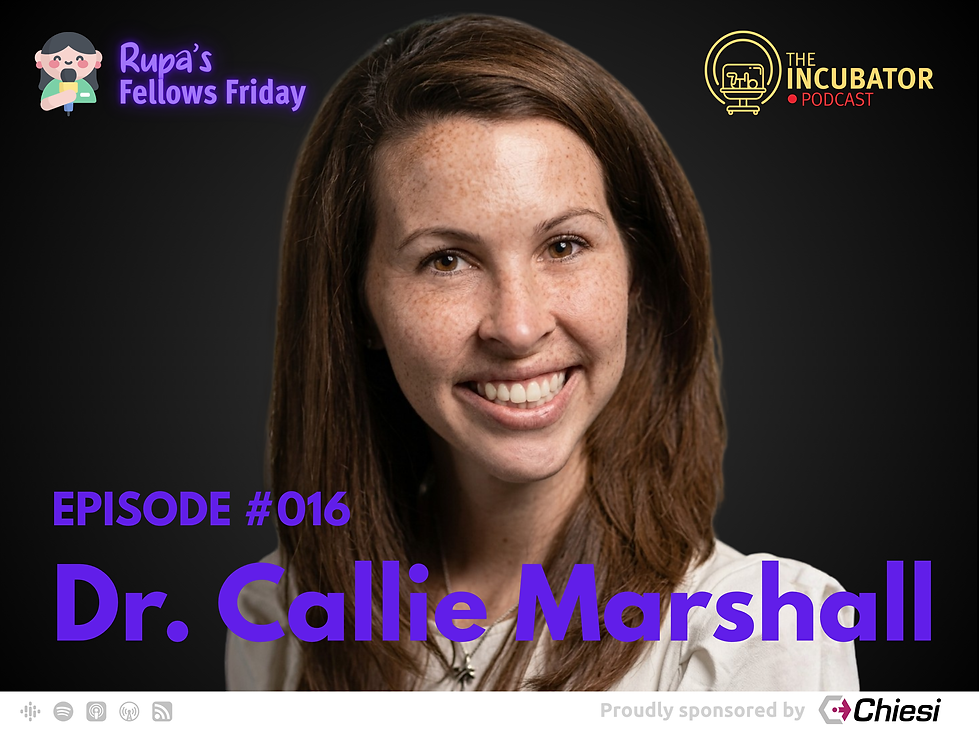
Hello friends 👋
In this episode, Dr. Callie Marshall, a third-year neonatology fellow at Washington University, shares her journey through medical school and fellowship, highlighting her research on racial variations in neonatal care. She discusses her mentorship experience, emphasizing the importance of finding a mentor who aligns with one's interests and values. Dr. Marshall elaborates on her research project that investigates the accuracy of near-infrared spectroscopy (NIRS) in assessing oxygen levels in black infants, revealing significant findings that contribute to the understanding of health disparities in neonatal care.
----
Short Bio: Callie is a in her sixth and final year of postgraduate medical training in neonatal-perinatal medicine fellowship at Washington University. She did her undergrad at the University of Texas at Austin where she majored in Plan II Honors and History with accidental minors in chemistry and biology because medical school pre-requisites will do that. She went to medical school at The University of Texas San Antonio Long School of Medicine where she graduated with a Master's in Public Health, a Doctorate of Medicine, and an MRS degree after marrying her husband Treston. She did residency in pediatrics at WashU and is a board-certified pediatrician!
----
The transcript of today's episode can be found below 👇
[00:00] Srirupa: Hi everyone, welcome to another fantastic episode of Rupa's Fellows Friday. I have with me Dr. Callie Marshall from Washington University, who is currently a third-year neonatology fellow. Callie did her medical school at the University of Texas San Antonio, then went on to do her residency and subsequently her fellowship in neonatology at Washington University. I'm very excited to hear all about the work she's been doing in fellowship. Welcome, Callie. How's your day going so far?
[00:28] Callie Marshall: Thank you. It's been a day for sure, but I'm here.
[00:32] Srirupa: My day's been good as well. I was very interested in the abstract you sent and I want to hear all about the research projects you've been doing. But I'd like to start by asking what got you interested and how you found your mentor.
[00:51] Callie Marshall: I lucked out in that my mentor found me. I did my residency at the same institution where I'm doing my fellowship. We'd worked together and, right after I matched, at our Christmas party for faculty and residents, he said, "Hey, you should join my lab." My program directors, Sam and Jen, are really good at setting up scholarship oversight committees early on. So before fellowship even started, I knew who was going to be on mine and who I was going to be working with.
I didn't have a clear sense of what I wanted to do specifically, but I knew I liked neural development, neuroprotection, and sedation and analgesia. My mentor runs a neonatal neurophysiology lab and does a ton of work with big data and AI. I joked the other day, "Zach, I think I'm just riding your coattails to success." And he said, "Yeah, but I think that's the goal of a mentor — to shepherd you along." He's incredible.
So I wanted to join his lab. I knew he was fun to work with and very smart. I'd published before and knew I'd get a lot of good experience in publishing and research. He had a project he'd already conceptualized and said, "Do you want to do this one?" He wanted to look at racial variation in NIRS (Near-Infrared Spectroscopy) accuracy.
There's an adult body of literature, which became more prominent during COVID, finding that adult African-American patients are more likely to have what's called occult hypoxemia — where the pulse oximeter reads normal oxygen saturations, but an arterial blood gas reveals the patient is actually hypoxemic. The proposed reason is interference from melanin, which is known to interfere with light waves. Zach had done the first study in preterm babies and also found an increased burden of occult hypoxemia specifically among Black infants.
He was curious whether the same principle applied to NIRS. Near-infrared spectroscopy uses the same principle as pulse oximetry — light reflecting off oxygenated and deoxygenated hemoglobin — but NIRS looks at venous, arterial, and capillary blood together, capturing all the blood in a tissue rather than just arterial. We ended up looking at babies in the Cardiac Intensive Care Unit (CICU), since we don't routinely use NIRS in our general NICU and the CICU had the largest population already on NIRS. We had something like 600 babies in our dataset.
[03:12] Callie Marshall: It was a labor of love. It took many months to pull the data, and then re-pull it. I also looked at central line tip position — whether it was in the superior vena cava (SVC) or inferior vena cava (IVC) — but we ended up not using that because we only had reliable cerebral NIRS data, so we went with cerebral NIRS alone.
It was a lot of time doing very methodical, repetitive tasks. I listened to a lot of podcasts and put TV shows on in the background — just stimulating enough to stay engaged, but not so distracting that I couldn't work. In the end, we found that NIRS in Black infants underestimates oxygenation by about 3%. That's the first time anyone has really looked at this in this population.
That said, NIRS is different from pulse oximetry. Pulse ox has clearly established clinical thresholds — in neonatology, we typically target 90 to 95%, and there are well-studied trials to support that. NIRS thresholds, by contrast, are much more variable and patient-specific. We concluded that this finding is probably not clinically meaningful in the same way, given how broad the range of normal is for NIRS. But I think it was important to begin examining this question. The project gave me the opportunity to do other things that aligned more closely with my deeper interests. I learned a great deal and got to work with really remarkable people.
[04:43] Srirupa: Absolutely. Just like you said about pulse oximetry — the fact that there is variation based on melanin was already a significant finding. We had looked at some of that data in relation to the Oxygen Saturation Index as well — looking at racial variation in how it's captured based on melanin. It's still a growing body of evidence. So I think it's very valuable that you extrapolated that question into NIRS, which is such an important tool. I'm curious — what were some of the variables you accounted for when estimating NIRS values? Cerebral NIRS can vary based on sedation, activity level, intraventricular hemorrhage (IVH), patent ductus arteriosus (PDA), and so on.
[05:31] Callie Marshall: Everything. Everything you could imagine affects it, which is part of why it's so hard to think critically about NIRS in clinical practice. It's a balance between oxygen supply and demand, and figuring out which side is driving the reading. We actually didn't account for confounders in our model. One of our reviewers asked why we didn't include hemoglobin. The honest answer is that we only had the mixed venous saturation, and trying to also identify which babies had a contemporaneous hemoglobin level would have collapsed our sample size.
We didn't account for anything because we were comparing each baby against themselves. For every mixed venous saturation measurement, we averaged a 60-second window of that same baby's cerebral NIRS value at the same time — asking whether their own NIRS compared accurately with their own mixed venous saturation.
We did find that Black infants overall had lower cerebral NIRS and lower mixed venous saturations. We also looked at the STS (Society of Thoracic Surgeons) STAT mortality score — a one-to-five grading system based on cardiac pathology and repair complexity — to compare physiologic complexity between groups. The scores were pretty similar across the two populations, which actually speaks to the broader body of literature on inequity in outcomes for Black patients in the CICU. That's been fairly well established. It was a sobering finding. We didn't have an answer for it beyond: we see this, it's not acceptable, and we wish it were different.
[07:09] Srirupa: That's really valuable work. You mentioned that this project opened a door to a new interest — the patient- and family-centered care model. Can you tell me how that connection happened, how active you are in that space, and what you envision for your future there?
[07:30] Callie Marshall: That connection came through my Scholarship Oversight Committee (SOC). When I was building my SOC, the advice was to find people who see you and whose work you find compelling. I knew I cared about neurodevelopment, but I also knew I'm not cut out to be a physician-scientist. Research is not my primary skill set. I wanted to learn it — and Zach has been phenomenal at teaching me — but I also recognized that my real strengths are in education and communication. My SOC included someone who does benzodiazepine research in the PICU, because I knew I was interested in sedation, and someone who does family-centered care research, also in the PICU. I'd heard her speak at Grand Rounds the year before.
In my second year, at one of my SOC meetings, a colleague named Cindy Ortenow — who I'd worked with before — said to me, "Callie, I've seen you in the unit. Your passion for teaching and family communication is so evident. I really think you should start building your career in that direction." That was the first time someone encouraged me to step back, reflect on what I'm genuinely good at, and begin intentionally building toward that.
Another member of my SOC, Mallory Smith, who does extensive family-centered care research, mentioned that pediatric fellows can join the Patient and Family Advisory Council (PFAC) at our institution and suggested I consider it. I already knew the family partner who runs it — Emily — and reached out right away. We meet once a month to discuss the patient and family perspective and think about how to optimize the experience outside of the medical care itself. One recent example: they did a big survey asking parents what they needed, and families said their top concern was the trash. The bins in their rooms were always overflowing. It's a small thing, but the point is the importance of actually asking families rather than assuming you know what they need.
[09:52] Callie Marshall: My most recent PFAC highlight was being involved when the unit decided to do a Wicked photo shoot — selecting six babies to wear little crocheted costumes for the Wicked premiere as part of a children's hospital PR campaign. I helped pick which baby wore which role. One mom got an email saying her son was going to be the scarecrow and reached out wondering what it was all about. I was able to tell her: I picked your son because your family's room had a farm theme — the dad was a farmer — and I thought it would be a perfect fit. Little things like that, bringing joy to families in the unit, have been really meaningful. I want to keep doing work in the family-centered care space.
[10:18] Srirupa: That's fantastic. And I can really relate to the importance of incorporating family perspectives. I'm a big advocate for caring for dads in the NICU as well — because yes, mothers absolutely need support, but fathers have their own distinct risk factors for stress that often go unaddressed. Can you share some of the
perspectives that come up most in your PFAC work?
[10:48] Callie Marshall: The physical environment of the room has been a big theme. Our PFAC serves the whole hospital, but there's a strong NICU presence, which makes sense — families stay with us for so long that we build really special connections. Beyond the trash issue, we've talked about food, how it's working for families, and ways to connect families with each other.
I actually met with Emily to discuss building a NICU-specific PFAC — exploring what that might look like and how to get families out of their rooms to meet one another. Her first piece of advice: you have to have food. You will not get people to come without feeding them. And having been a college student, a medical student, and a resident — yes, absolutely. If you feed them, they will come. The NICU had a breastfeeding support group that no one was attending until they offered lunch. Then people showed up in numbers.
We've also talked about communication. The family-centered care literature consistently shows that families want information that is honest, hopeful, and actionable. So we've been thinking about how to provide that — for example, a lunch-and-learn format where physical therapy (PT), occupational therapy (OT), or speech therapy comes in to talk about supporting their baby's development at home. Little actionable things families can do. That's still in the back-burner stage, but it's an idea we've been working through. Families repeatedly say, "I wanted to feel like I was doing something. I didn't want to just sit there." So trying to give them agency is a priority.
Emily's own perspective is invaluable — she had two babies in the NICU, one with complex medical needs and one without. That breadth of experience makes her voice really important.
[12:36] Srirupa: That's wonderful. How do you plan to carry this interest forward in your career as a neonatologist? Graduation is coming up soon — how do you see this expanding?
[12:50] Callie Marshall: I'd love to be on whatever version of a patient and family advisory council exists at my next institution. I also really enjoy education. I put together a small fact sheet for our NICU — "Your baby is a small baby — what does that mean?" — explaining what that designation means for families. I've also heard some really interesting fellows' projects on The Incubator that are communication-oriented and that I'd love to implement.
One recurring theme is that parents want written information, and we see that in the literature over and over — but what does that actually look like in practice? How do we build meaningful written materials for them? We know that families in crisis often don't retain what they're told verbally, so having something written to reflect on later is really important. Fetal care is also an interest of mine, so I'm thinking about how to direct parents toward reliable information about their child and provide written materials they can take home. Writing is more my strong suit than speaking, so I think that's how I want this to come together: written resources for families, plus involvement in whatever PFAC structure is available.
[13:58] Srirupa: That's wonderful. The American Academy of Pediatrics (AAP) also has a family-centered care task force, which is a great resource for incoming fellows — you can get involved from the very first year and learn about family-centered approaches and initiatives across different institutions.
And I want to ask you about this too, because it sounds like you've had a really fruitful fellowship experience with research. But I'm sure no fellow would tell you it came without its challenges. Share some of the harder moments — including the uncertainty around where things were headed.
[14:48] Callie Marshall: The amount of time and energy I spent locating the central line tip for every single baby was painful. Going through all those X-rays trying to determine whether the line was in the upper or lower position, how long it had been there — and then we didn't use any of it. We didn't end up using line tip position. There are other papers taking a similar approach, and it's not a perfect method, but using it would have broadened our sample size. So not being able to include it was a real blow. When we ran the analysis and realized we couldn't use it, I was devastated.
Another thing I learned — too late — was about data formatting. Zach does a lot of work with computers and coding, and as a liberal arts major, I had built my own color-coded system for organizing data. He eventually said, "Callie, this needs to be binary. It needs to be readable by a computer." I had to go back and redo a significant portion of my data entry. I really wish I had asked upfront: how do you want this formatted? Let's establish a binary system from the beginning.
There were a couple of other things we tried during fellowship that didn't pan out. One was looking at light and sound data from some of our incubators — there are a few papers in that area, and our incubators were collecting data, so we thought, let's look at it. I spent a lot of time going through that data only to find that the collection quality was inconsistent across units. That was several weeks I won't get back.
But through all of it — publishing the paper, presenting at conferences, meeting leaders in the NIRS field like Valerie Chock at Stanford ⚑ and Lena Shalek at Southwestern ⚑, and now collaborating with Stanford on another project — it was worth the many months of data pulling. Podcasts and TV shows definitely made it more bearable.
[17:04] Srirupa: Totally. Always check with whoever is running your statistics — before you arrange a single cell — how they want the data structured. Experience teaches that lesson fast. After my first couple of fellowship projects, I made a rule: I don't touch the Excel sheet until I've spoken with the statistician. Good advice for any fellow listening: do not touch how your spreadsheet looks until you've talked to your stats person.
[17:30] Callie Marshall: Yes — if it needs to be binary, make sure it's binary from day one. Have a system. Another thing I learned — not really a failure, but a significant insight — came through Cindy Ortenow again. I wanted to join another guideline committee, and I think many fellows fall into that trap of wanting to say yes to everything. She brought me into her office, had me write out everything I was involved in on the whiteboard, and then asked: "How does this connect? What does this tell me about who you are?" She advised me not to join that particular committee. She said, "I don't think it aligns with what I think you want to do."
That was so helpful. We all want to join everything, but she pushed me to really tailor my choices — because you can't do everything well. You need to think carefully about who you are as a fellow and as a physician, what you love, and how each experience contributes to the story your CV will one day tell. Not a failure — but a very real lesson in intentionality over volume.
[18:34] Srirupa: Absolutely. Fellowship is one of those rare periods where you're finally doing the thing you actually got into medicine for. After years of training through things you didn't necessarily care for, you're finally where you want to be — and naturally, you want to say yes to everything that interests you. But it takes a good mentor to tell you to slow down and learn how to say no. That skill is so important and so hard-won.
Which brings me to my next question: if you were talking to an incoming fellow — one who is interested in your line of research, or one who is coming in with absolutely no idea what to do, which is most of us — what advice would you give?
[19:30] Callie Marshall: I came in with just a vague sense of what I liked and nothing very specific. I think having good mentors makes the biggest difference. Even though racial variation in NIRS wasn't something that immediately jumped out to me as my passion, I respected and enjoyed working with Zach so much that it was worth it. Being with the right person matters more than the perfect project, especially at first.
Be really thoughtful about your SOC. Mallory's recommendation to join the PFAC turned out to be one of the most important things for my development. Find someone you genuinely enjoy working with, whose work you find compelling or could at least get interested in. Through Zach I got to write a paper with one of our pharmacists on neonatal pain and analgesia — an opportunity I would never have had otherwise.
My dad always said growing up, "It's not the grades you make, it's the hands you shake." I think it's both — you have to do the work — but the connections I made through Zach have been invaluable. Find a mentor you like, because you're going to be meeting with them every week. Find someone who does work you respect, even if it's a stretch from your exact interest. And build your SOC with people who can add different perspectives. Having that family-centered care side was something I really, really valued.
[20:53] Srirupa: Fantastic advice. And I think good mentorship also makes you a better mentor in the future — you take notes on how to show up for the people who will one day look to you. This has been a wonderful conversation. I'm sure you have a very long and beautiful career ahead of you, advocating for your patients in all the ways you've described. Thank you so much for being on this episode, and I wish you all the best in everything that comes next.
[21:31] Callie Marshall: Thank you so much. This has been so fun.


Bahut achhi information share ki gayi hai. Varnmala in Hindi ke basic letters samajhne mein bachchon ko zaroor help milegi.